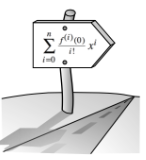
12.1.1Can you name the mystery function?
Approximating with Polynomial Functions
In Chapter 10, you saw that polynomial functions could be created to mimic the behavior of non-polynomial functions near some shared point. We are now ready for a more definitive study of these special polynomial functions. You will learn how these polynomials are constructed as well as their accuracy in approximating the desired function.
On you calculator, sketch a graph of the ninth-degree polynomial function
Describe the graph of
. Which common function does this graph remind you of? Name this common function . Graph
and on the same set of axes. Over what interval does f closely approximate ? Notice that there is a pattern among consecutive terms of
. If had one more term, make a prediction about what the next term would be:
Input this newinto your calculator and compare with . What did you notice? Use your calculator to explore what happens when
has ten terms. Then compare it to .
MYSTERY FUNCTION, Part One
Your diabolical teacher gives you the following puzzle:
Clues: Your Challenge: Write a possible equation for |
Write the equation of mystery polynomial.
Describe your method.

MYSTERY FUNCTION, Part Two
She is at it again! Your teacher is thinking of another mystery function. This time she wants you to estimate a specific value of a function.
Clues: Your Challenge: Estimate the value of |
Notice that your teacher did not tell you if
is (or is not) a polynomial. But that should not stop you! Write a polynomial, , that models the mystery function, . Then calculate . How close do you think
is to the actual value of ? Explain your thinking.
MYSTERY FUNCTION, Part Three
This time, your diabolical teacher challenges you to play the game in reverse.
Clues: The mystery function is a third-degree polynomial, Your Challenge: Write an equation for |
If the graph of
looks like the graph of near , then and should have the same value, slope, and concavity at . With your team, determine the values of:
, , , Use the information from part (a) to write a polynomial that looks a lot like
near .
MYSTERY FUNCTION, The Strategy
Let’s find a general way to build a polynomial,
Justify why this first-degree polynomial has the general equation
. Write the general equation for
. Write the general equation for
. Look for patterns! Write the general equation for
, where is a positive integer.
During each round of the Mystery Function Game, your diabolical teacher challenged you to write a polynomial function that looks a lot like another function that might or might not be a polynomial! A polynomial of this type is called a Taylor polynomial.
All three “mystery polynomials” in this lesson were “centered” about
When writing Taylor polynomials, it is important to decide how many terms to include and what degree the polynomial should be. Refer back to the Taylor polynomial you wrote in problem 12-4 for
. How many terms were did it have? What degree was it? Write an equation for
, the first-degree Taylor polynomial for centered at . Use your calculator to graph and on the same set of axes. What does the graph of represent in relation to ? Evaluate
and determine if gives an underestimate or an overestimate of . Justify your answer.

Recall what you know about translations of functions. Homework Help ✎
What is the equation of the parabola that is identical in shape to
, but has its vertex at ? Write an equation of a cosine curve that has a maximum at
.
Consider the infinite series below. For each series, decide if it diverges, converges conditionally, or converges absolutely and justify your conclusion. State the tests you used. Homework Help ✎
A bug is climbing up a wall. When the bug starts out, it has the energy to climb up quickly, but as time passes it tires, and climbs more and more horizontally on the wall, which is less work than going up. The bug’s climb can be modeled by the derivative equations
.png)
Calculate the area of the region enclosed by the polar curve
A particle moves along the curve
.png)
Write the equation of a third-degree polynomial function
Multiple Choice: The arc length of the cardioid given by


